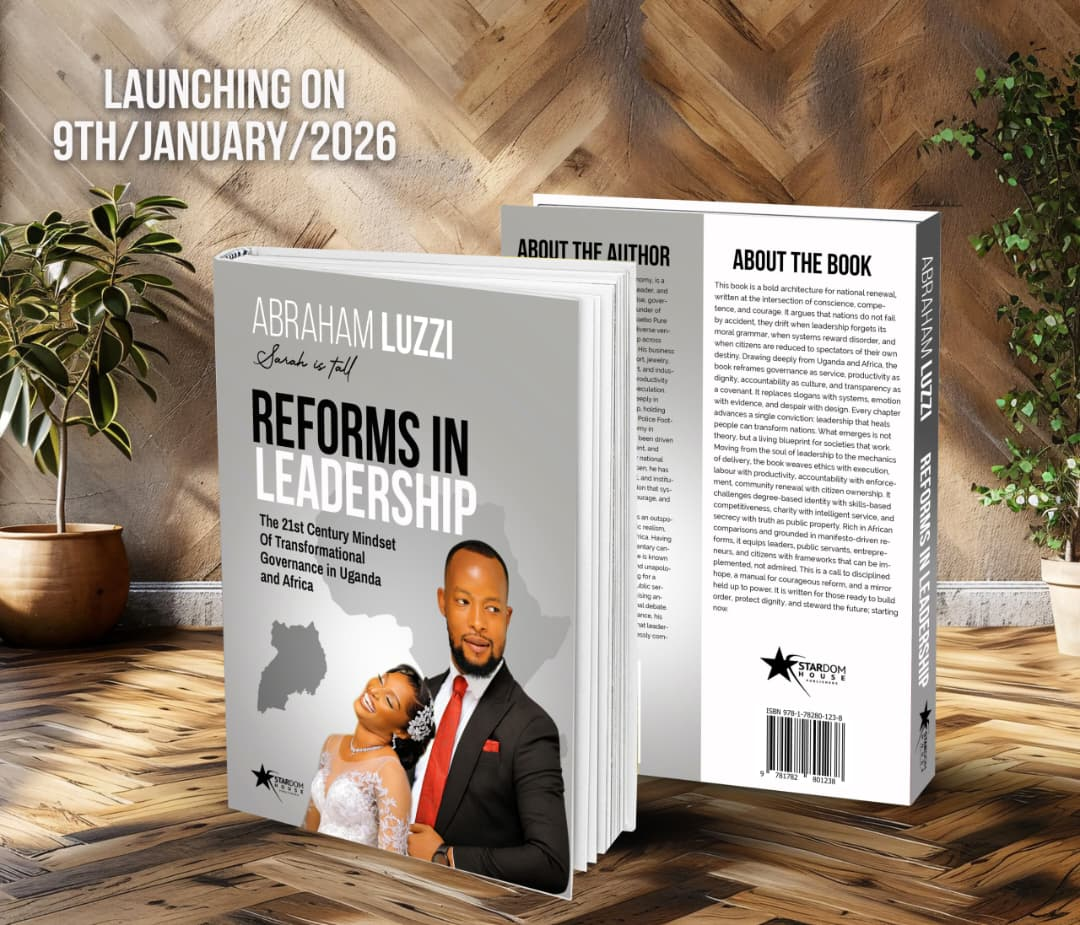
In an era where leadership often gets tangled with control and power, Abraham Luzzi’s Reforms in Leadership challenges the status quo. At its core, the book seeks to redefine leadership, not as a tool for dominance, but as an instrument for healing, service, and effective governance.
Luzzi’s work comes at a time when the world is grappling with crises of trust in institutions. As people question what leadership is truly for, Reforms in Leadership answers with a powerful proposition: leadership must prioritize service and accountability, not power and control. Luzzi offers a roadmap to leadership that values integrity, competences, and genuine transformation over traditional political rhetoric.
Leadership as Service: A Radical Reframing
Luzzi presents a radical departure from the conventional understanding of leadership. Instead of viewing leadership as a means to control, he argues that it should be an act of service to the people. By focusing on service, leaders can better understand and address the needs of their constituents.
True leadership, Luzzi asserts, is not about the leader’s ego or ambitions, but about the betterment of society. It requires empathy, collaboration, and a deep commitment to the well-being of the people. Leaders must be facilitators of change, not figures who impose their will. This paradigm of leadership places the needs and aspirations of the people at the center, making the role of leadership not one of dominance but of stewardship.
Competence and Accountability: The Twin Pillars of Leadership
At the heart of Luzzi’s work lies the argument that leadership must be rooted in competence and accountability. Competence ensures that leaders have the necessary skills and expertise to navigate the complexities of governance. Accountability ensures that leaders are held responsible for their actions and decisions.
Luzzi makes the case that too often, leaders are selected based on their political connections or credentials rather than their ability to lead. He challenges the conventional wisdom that leadership is a privilege that comes with a title. Instead, he proposes that leadership should be earned based on demonstrated competence and the ability to deliver tangible results. Moreover, accountability is crucial in ensuring that leaders remain transparent, responsible, and answerable to the public.
From Ethical Leadership to Real-World Execution
One of the distinguishing features of Reforms in Leadership is its emphasis on execution. Luzzi is clear that while ethical values and leadership principles are vital, they are meaningless without practical implementation. His book connects ethics and values to real-world outcomes. Leadership, he argues, is about transforming values into actions, ensuring that ethical principles lead to tangible benefits for society.
Luzzi rejects idealistic theories that are disconnected from the realities of governance. Instead, his work offers practical guidance on how to translate values such as integrity, transparency, and service into actionable plans. He links leadership with results, showing how the ethical foundation of leadership can translate into effective governance and measurable improvements in the lives of citizens.
Challenging the Old Guard: A New Way of Thinking
Luzzi’s work also challenges long-held assumptions about leadership. He critiques credentialism, which often elevates individuals to leadership positions based on their qualifications rather than their actual ability to lead. He advocates for a focus on skills-based leadership, where leaders are chosen based on their capacity to deliver results rather than their pedigree.
Moreover, Luzzi questions the reliance on charity in governance. Rather than relying on charity or aid, he argues, leadership should be about providing sustainable and intelligent service that empowers people. This shift in thinking demands that leaders prioritize systemic solutions over temporary fixes and that they treat citizens not as recipients of charity but as active participants in shaping their own futures.
A Global Vision for Leadership
Although Reforms in Leadership is deeply rooted in African experiences, Luzzi’s vision extends beyond national borders. He presents a universal framework for leadership that can be applied in any context, from local governments to global institutions. His emphasis on leadership as service, competence, and accountability is relevant to societies everywhere that seek to rebuild trust and improve governance.
Luzzi’s work speaks to the need for a global movement toward more effective, inclusive, and ethical leadership. In an increasingly interconnected world, the principles he espouses offer a path forward for societies that want to move beyond the challenges of corruption, inequality, and ineffective governance.
Leadership for All: A Call to Action
One of the most important aspects of Reforms in Leadership is its call to action. Luzzi’s message is not just for politicians or public servants, but for all who hold leadership roles — whether in the public sector, private industry, or civil society. He emphasizes that sustainable reform does not begin with rhetoric or promises, but with a commitment to building systems that reward competence, integrity, and results.
This is a book for anyone who seeks to make a difference — from business leaders to educators, from community organizers to policy makers. Luzzi’s message is clear: leadership that restores people can transform nations, and it is up to all of us to be part of that transformation.
Where to Get Reforms in Leadership
Reforms in Leadership is available in both eBook and physical formats. The eBook edition can be purchased on major platforms like Amazon, while physical copies are available for international order. In Kenya, readers can preorder signed copies, reflecting a growing interest in ideas that prioritize order, dignity, and sustainable governance over short-term political gain.
Abraham Luzzi’s Reforms in Leadership offers a fresh and powerful vision of leadership. His call for leadership that serves, that is competent, and that is accountable presents a blueprint for a better future. This book is not just for leaders, but for all those who care about the future of governance and society. By focusing on practical reforms and real-world execution, Luzzi offers a roadmap for leaders who are ready to build a better future for all.
Luzzi’s work is a reminder that leadership is not about power; it’s about service. It’s about creating systems that work for the people, building trust, and fostering accountability. This is the leadership we need to move beyond the challenges of the present and into a more just, effective, and prosperous future.