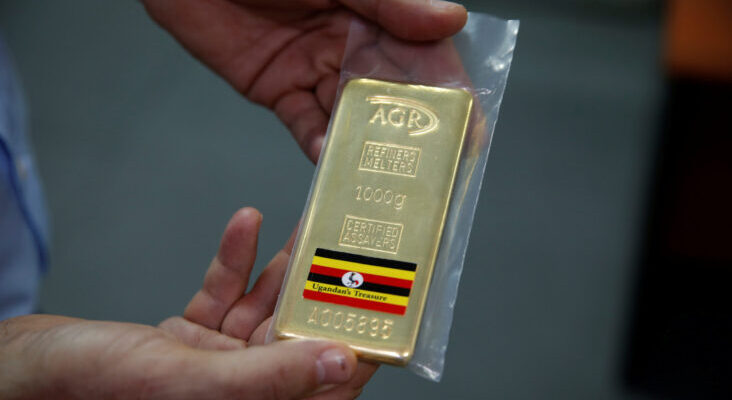
Uganda may soon establish mineral markets as part of efforts to ensure that minerals produced in the country benefit the economy and Ugandans generally. The country is endowed with vast mineral resources, including gold, lithium, copper, and rare earths. However, concern exists within the government and among development actors that the mining sector’s contribution to the economy remains minimal. The Uganda Bureau of Statistics said the sector contributed just 2 percent to Uganda’s GDP in the 2022/23 financial year. The Ministry of Finance indicates that today the sector contributes less than 1 percent to GDP.
The government lists mining among sectors that could contribute to domestic revenue mobilization and long-term structural transformation. Mining is one of the likely contributors to the ten-fold economic growth ambition from USD 50 billion to USD 500 billion by 2040. Yet gold, which dominates mineral exports, operates within what experts describe as a corridor of corruption and shadowy deals. The country lacks a traceability mechanism to ensure accountability from gold sales. Therefore, Uganda is turning to mineral market reforms introduced in neighboring Tanzania.
Tanzania’s Success Story in Mineral Market Reforms
Tanzania’s Ministry of Minerals said on March 13, 2026, that mineral transactions rose from just 8 billion Tanzanian shillings in 2018/19 to over 2 trillion shillings in both 2023 and 2024. What was once unrecorded is now measured, taxed, and reinvested. These trades occurred through official markets with sales officially recorded. Tanzania boasts 44 mineral markets and 120 mineral buying centers spread around areas with mining activity.
In mining hubs like Chunya, gold production surged from 5 kilograms per month to about 300 kilograms. This increase reflects not just higher output but a system that captures what was previously invisible. Today, the mineral sector contributes more than 10 percent of Tanzania’s GDP. It employs over 6 million people and accounts for more than half of the country’s non-traditional exports.
Uganda Studies Mineral Market Reforms After Benchmarking Visit
Teams from Uganda’s Ministry of Finance and the Ministry of Energy and Mineral Development have conducted benchmarking trips to Tanzania’s gold-rich market. Mercy Gillian Lawino, an economist at the Ministry of Finance, was part of the delegation. She said Uganda was impressed by the idea of mineral markets. In those markets, workers weigh, test, and value minerals in one place. Taxes and fees are deducted transparently before miners receive payment.
“That system has simplified compliance and improved traceability,” said Lawino. She spoke at a convening hosted by the Natural Resource Governance Institute (NRGI), in collaboration with the Advocates Coalition on Development and Environment (ACODE) and the Civil Society Coalition on Oil and Gas (CSCO). Lawino said that if implemented effectively, such markets could address one of Uganda’s most persistent challenges. That challenge is knowing exactly what the country produces, sells, and exports.
However, Lawino expressed frustration with government bureaucracy. No action has been taken toward a policy shift by the Ministry of Energy and Mineral Development. In Tanzania, mineral trading has shifted from shadowy informal deals to structured, state-monitored markets generating trillions in revenue. In Uganda, the sector remains plagued by fragmentation, data discrepancies, and persistent revenue leakages.
Structural Problems Hamper Uganda’s Mining Sector
Kenneth Asiimwe has spent years working with artisanal and small-scale miners, the backbone of the industry. From his vantage point, the problem is clear: too many authorities, too little coordination. Licensed miners often find themselves caught between agencies. One agency shuts them down, another clears them, before they can even begin production. “You are being closed and reopened before you even mine,” he says. “The more you organise, the faster we produce the revenue the government is looking for.”
Asiimwe is the CEO of the Uganda Association of Artisanal and Small-Scale Miners. He says that for miners operating in remote areas without internet access, even basic requirements like filing tax returns become impractical. The result is a system where compliance is difficult and enforcement uneven. “Taxation should not be something I hunt for,” Asiimwe adds. “Bring it to the mine and make it simple; people will pay.”
Gloria Kempaka Mugambe has seen the inconsistencies firsthand. As head of Uganda’s Extractive Industries Transparency Initiative, her work depends on reliable figures. But those figures rarely align. “My main concern really is the continued discrepancies in production volumes, in revenues, being reported by the different agencies that we have, which are mandated to give us these figures.”
Mugambe notes that a consistent challenge the secretariat faces is different figures from different government agencies. Production data from the Ministry of Energy often differs sharply from export figures recorded at border points. In some cases, more gold appears to leave the country than is officially produced. The implications are significant: lost revenue, weak accountability, and a system vulnerable to exploitation.
Path Forward for Mineral Market Reforms in Uganda
For economist Edmond Ariyo, the issue goes beyond data. He points to deeper structural problems: low formalisation, regulatory bottlenecks, and policy inconsistencies that send mixed signals to investors and miners alike. The government has maintained restrictions on the export of raw minerals while simultaneously granting exceptions in certain cases. “There are gaps across the entire value chain,” Ariyo says, “from production to beneficiation, and inconsistencies between tax and sector laws.”
Questions linger about enforcement of newly enacted laws and policies. Members of security agencies deployed for enforcement have turned into mineral smugglers. Specialised mineral police units exist, yet smuggling persists. Certification systems are in place, yet minerals move across borders with limited oversight. For Asiimwe, the answer is not stricter enforcement alone but smarter regulation. “Business will always survive policy if policy is unfair,” he says. “The solution is to meet halfway and simplify.”
As traditional sources of external financing decline, Uganda faces increasing pressure to generate domestic revenue. The mineral sector, rich, largely underexploited, and globally in demand, offers a clear opportunity. Tanzania has shown what mineral market reforms can achieve: a sector that generates revenue, creates jobs, supports local economies, and contributes significantly to national development. In Uganda, the minerals are there, and demand is rising, yet the systems to harness revenue remain dysfunctional.
To move forward, policymakers could take several immediate steps. These include setting up a clear roadmap for establishing formal mineral trading centers, streamlining regulatory requirements for miners and traders, and strengthening collaboration between relevant government agencies. The government could also prioritize investing in reliable data collection systems. Pilot programs in key mining districts could test traceable and transparent mineral transactions. By taking these practical first steps, Uganda can lay the groundwork for a more accountable and profitable minerals sector.