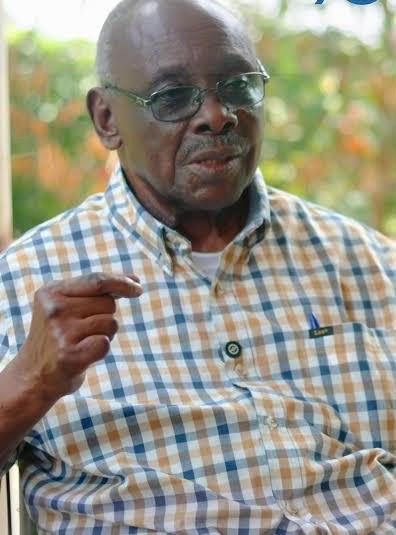
Dr Louis Mukwaya, one of the scientists whose work helped preserve Uganda’s long tradition of virus and mosquito research, has died at the age of 87.
The Uganda Virus Research Institute announced his death on Monday, September 28, remembering him as a former acting director, head of entomology, assistant director of research and its longest-serving staff member.
Mukwaya died on Sunday, September 27. The cause of death had not been publicly disclosed by the institute at the time of the announcement.
His career stretched across more than half a century and included scientific research, institutional leadership and the training of younger researchers.
But perhaps one of the most remarkable parts of his story happened during Uganda’s turbulent 1970s, when political upheaval threatened the survival of the research institute itself.
Mukwaya and a small team stayed.
Their decision helped preserve decades of scientific materials, knowledge and research that might otherwise have disappeared.
Dr Louis Mukwaya Became UVRI’s First Ugandan Scientist
Mukwaya was born in 1939 in Kangavve village in what is now Luweero District.
He studied zoology at Makerere University College beginning in 1960.
It was during his university years that he developed a strong interest in mosquitoes and the diseases they transmit.
Lectures describing mosquito research taking place in Zika Forest near Entebbe particularly captured his attention.
That interest eventually shaped the rest of his professional life.
In August 1965, Mukwaya joined what was then known as the East African Virus Research Institute as a trainee entomologist.
According to UVRI’s historical account, he became the first Ugandan scientist appointed to the institute’s scientific staff.
His arrival also came during a period when institutions inherited from colonial rule were gradually bringing more African scientists into senior professional positions.
Mukwaya would eventually become far more than a new recruit.
He became one of the people responsible for ensuring that the institution survived.
A Career Built Around Mosquito Research
Dr Louis Mukwaya specialised in medical entomology, particularly the study of mosquitoes that transmit diseases.
His research included work on Aedes simpsoni, a mosquito associated with the transmission of several arboviruses.
For his doctoral research, Mukwaya studied the genetic factors behind the mosquito’s feeding preferences.
That work later took him abroad for advanced scientific training.
In 1973, he received a World Health Organization-supported postdoctoral fellowship at Princeton University in the United States.
The opportunity could easily have become a permanent move.
Uganda was becoming increasingly unstable under Idi Amin’s government, and Mukwaya’s supervisor reportedly encouraged him to remain in the United States.
Instead, he returned to Uganda in late 1974.
He wanted to continue research that depended on mosquito populations available in Uganda.
That decision would soon place him at the centre of UVRI’s struggle for survival.
Dr Louis Mukwaya Helped Keep UVRI Alive During Political Turmoil
By the middle of the 1970s, Uganda’s political and economic situation had deteriorated sharply.
Scientists and professionals were leaving the country.
Basic supplies became difficult to obtain.
At the virus research institute in Entebbe, both the director and deputy director eventually left Uganda.
Then, in 1977, Idi Amin withdrew Uganda from the East African Community, which had previously overseen the regional institute.
The facility was nationalised and became the Uganda Virus Research Institute.
Only a small group of workers remained.
Mukwaya found himself serving as acting director. UVRI’s historical records list him as director between 1977 and 1979.
Keeping a sophisticated scientific institution functioning under those conditions was extremely difficult.
Yet abandoning the facility could have meant losing decades of research.
Scientists Kept Generators Running to Save Valuable Samples
The Uganda-Tanzania War added another layer of danger in 1978.
Normal scientific work became increasingly difficult.
But Mukwaya and his colleagues understood that the institute contained collections that could not simply be replaced.
Stored inside were virus isolates, sera, reagents and other scientific materials accumulated through years of infectious disease research.
Much of the collection depended on refrigeration.
If electricity failed for too long, the scientific value of those materials could disappear.
According to Mukwaya’s own later account, staff managed to keep generators operating with fuel obtained through sympathetic soldiers stationed near Entebbe airport.
Research slowed dramatically, but the institution survived.
That achievement is an important part of Mukwaya’s legacy.
The scientists were not simply preserving a building.
They were protecting decades of scientific knowledge.
Why Saving UVRI Mattered
Today, the Uganda Virus Research Institute is one of Africa’s most established infectious-disease research institutions.
Its history stretches back to 1936.
The institute conducts work in areas including arbovirology, immunology, epidemiology and entomology, while also supporting disease surveillance and diagnostics.
Its scientific history is closely linked with the discovery and study of viruses including Zika.
The virus was first identified in Uganda’s Zika Forest during research associated with the institute in the 1940s.
That means preserving UVRI’s scientific collections and institutional knowledge during the upheaval of the 1970s had consequences stretching far beyond Uganda.
The material preserved during those difficult years remained available to future generations of scientists.
Dr Louis Mukwaya Continued His Research After Amin
After Idi Amin was removed from power in 1979, Mukwaya continued building his scientific career.
The World Health Organization supported another fellowship that took him to the University of Florida.
There, he studied biological methods for controlling mosquitoes.
Mukwaya later secured international research support that helped rebuild scientific capacity at UVRI.
Funding he obtained through international collaborations also helped the institute acquire equipment.
According to the historical account he co-authored, some of that support financed UVRI’s first computer.
His career also took him to research institutions in the United States and Europe.
But Uganda remained at the centre of his work.
Research Took Dr Louis Mukwaya Across the World
Mukwaya collaborated with researchers at institutions including the Smithsonian Institution, the University of Notre Dame, laboratories in Florida, the British Museum and the Liverpool School of Tropical Medicine.
His expertise was also called upon during public health emergencies.
When Nigeria experienced a yellow fever outbreak in 1987, the World Health Organization brought Mukwaya in as a consultant to assist with investigations.
While working there, he collected Aedes mosquitoes from different locations and sent specimens back to Entebbe for further research.
His work contributed to a larger scientific effort to understand mosquitoes not simply as insects, but as important vectors capable of carrying diseases between people.
Scientists Named a Mosquito Group After Him
Mukwaya’s contribution to mosquito science eventually received an unusual form of recognition.
In 2009, mosquito taxonomists named a subgenus Stegomyia (Mukwaya) in his honour.
The recognition reflected his contributions to medical entomology, particularly his research involving Aedes simpsoni mosquitoes.
For a scientist who had spent much of his life studying mosquitoes, having his name formally incorporated into their scientific classification carried special significance.
It also placed his contribution permanently within the scientific literature.
Training Uganda’s Next Generation of Scientists
Dr Louis Mukwaya’s legacy was not limited to his own research.
He also spent years training younger scientists.
Some went on to hold senior research positions in Uganda and abroad.
UVRI’s historical account notes that Julius Lutwama, one of Mukwaya’s early trainees, later became an assistant director at the institute, while another former trainee, John Paul Mutebi, went on to work with the US Centers for Disease Control and Prevention.
Training younger researchers was particularly important in fields such as mosquito taxonomy.
Some scientific expertise depends heavily on experience accumulated over many years.
Without deliberate mentorship, that knowledge can disappear when senior researchers retire.
Mukwaya helped ensure it continued.
Protecting the Zika Forest Research Legacy
Mukwaya was also involved in efforts to protect Zika Forest.
The forest near Entebbe holds an important place in the history of virology because Zika virus was first identified there.
One of its best-known research structures is a tall steel tower historically used by scientists studying mosquitoes at different levels of the forest canopy.
Mukwaya advocated for the site’s preservation when development and timber harvesting threatened the area.
Research continues in the forest today.
Protecting the location helped preserve not only an important scientific site but also part of Uganda’s contribution to global medical research.
Dr Louis Mukwaya Saw Himself as a Custodian of Scientific History
Mukwaya described his role during UVRI’s difficult years as one of custodianship.
Research institutions are often remembered through discoveries.
Less attention is paid to the people who keep those institutions functioning between major discoveries.
For UVRI, that continuity was especially important.
The institute survived colonial rule, independence, political violence, war, economic hardship and repeated changes in international research priorities.
Mukwaya lived through many of those periods.
When much of Uganda’s institutional infrastructure was collapsing, he helped prevent one of its most important scientific centres from disappearing.
UVRI Has Grown Into a Major Research Institution
The institute Mukwaya fought to preserve has continued expanding.
In July 2026, Uganda marked UVRI’s 90th anniversary and launched an East African Community Regional Centre of Excellence.
UVRI today describes itself as a government health research hub and a World Health Organization collaborating centre.
Its scientists work on infectious diseases, disease surveillance, diagnostics and research that contributes to public health policy.
That modern institution exists because generations of scientists maintained it through periods when its future was far from certain.
Mukwaya was one of those scientists.
Uganda Loses a Pioneer of Medical Entomology
The death of Dr Louis Mukwaya closes a remarkable chapter in Uganda’s scientific history.
He entered the Entebbe institute as its first Ugandan scientist in 1965.
He became a mosquito researcher.
He trained internationally.
He returned home when staying abroad might have been easier.
He helped run UVRI when senior staff had left and Uganda was slipping deeper into turmoil.
He helped protect valuable scientific specimens during war.
And when stability gradually returned, he helped rebuild laboratories, train researchers and restore scientific connections between Uganda and institutions around the world.
His career demonstrates that major scientific achievements are not always single discoveries.
Sometimes they involve protecting the institutions that make future discoveries possible.
For Uganda Virus Research Institute, Dr Louis Mukwaya was one of the people who did exactly that.
The laboratories, collections and scientific traditions he helped preserve continued long after the political crisis of the 1970s passed.
And that may be one of the strongest measures of his contribution to Ugandan science.