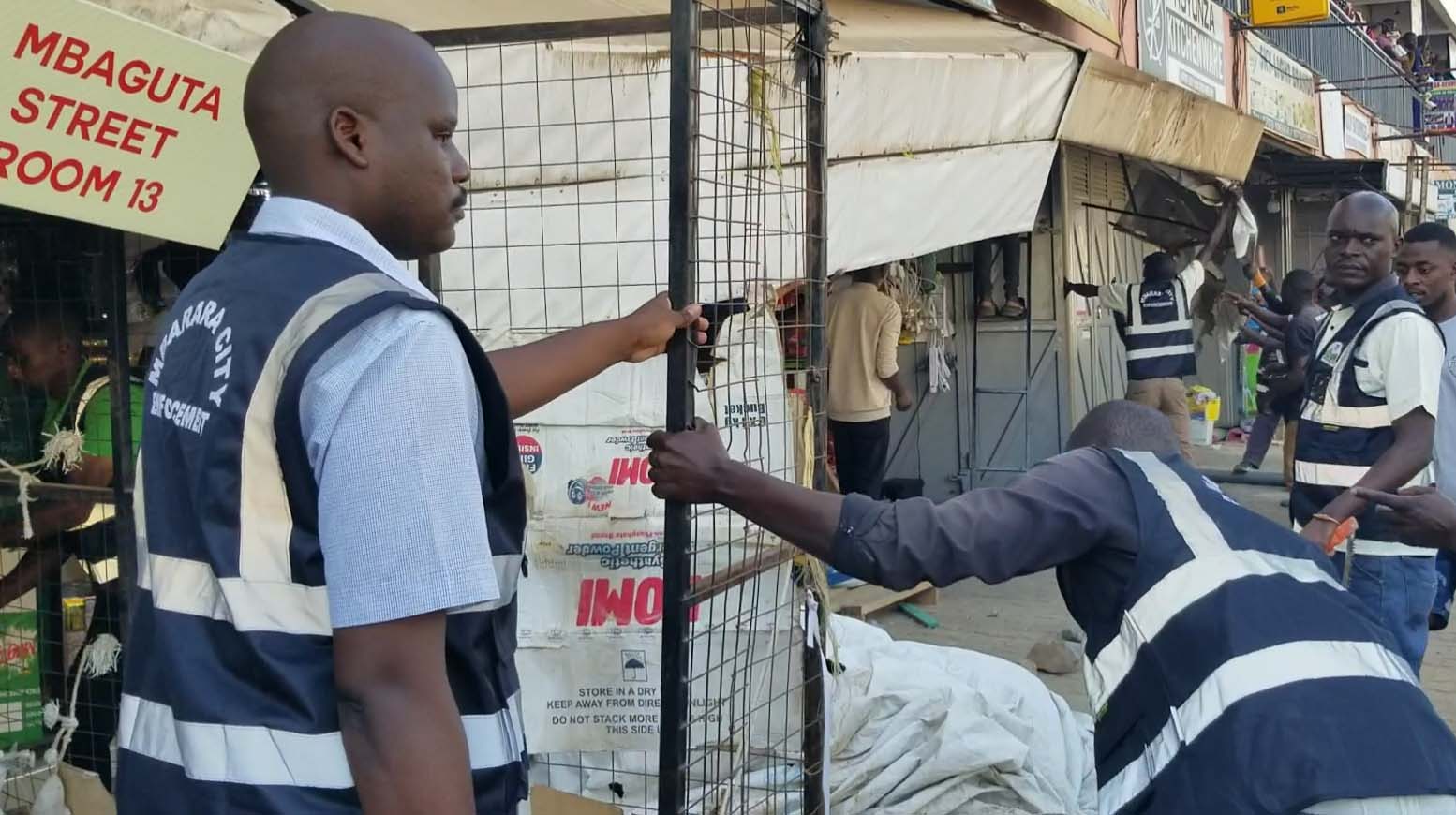
The Mbarara roadside trader eviction began Monday morning as city authorities removed several businesses operating along streets and road reserves. The operation targeted mobile money kiosks, makeshift stalls, and informal vendors occupying sidewalks and roadside spaces.
City enforcement teams moved through several busy trading streets early in the morning. As a result, many traders watched their kiosks and goods loaded onto trucks and taken to city council stores.
Officials say the Mbarara roadside trader eviction forms part of a broader effort to restore order and improve the city’s appearance. Authorities believe that uncontrolled street trading has created congestion, sanitation concerns, and unfair competition for registered businesses.
Sarah Nandawula, the Mbarara City South clerk, is leading the operation. According to her, the city plans to run the Mbarara roadside trader eviction exercise for about 20 days.
“This will benefit legal traders because they need it most,” she said. “We want to organize our city properly. Therefore, everyone must operate from gazetted markets and approved trading areas.”
Nandawula explained that the enforcement exercise follows existing city regulations. She stressed that traders who ignore the directive risk further legal consequences.
“This operation will take 20 days,” she said. “If we confiscate your items and you return them to the streets again, we shall summon you to court to explain why you continue trading illegally.”
She added that authorities remain determined to enforce the law. At the same time, the city leadership wants all traders to shift their businesses into designated markets.
“Tell those still operating illegally to stop,” she said. “We must put our city in order.”
For some business owners, the Mbarara roadside trader eviction represents long-overdue enforcement of trading rules. Several registered traders say roadside vendors have created unfair competition for years.
Viola Kembabazi, who operates a business along Mbaguta Street, welcomed the operation. She believes the city must protect traders who follow the law and pay taxes.
“Usually councils start these operations but fail to sustain them,” she said. “Yet we pay trading licenses and taxes to the Uganda Revenue Authority.”
Kembabazi argued that roadside vendors avoid many of the costs that licensed traders face. Consequently, they often attract customers away from established businesses.
“Those who sell along the roadsides make money without any costs,” she explained. “Meanwhile, we operate inside shops and must pay rent, taxes, and licenses.”
She also noted that roadside traders sometimes block entrances to formal businesses. As a result, customers struggle to access legitimate shops.
“They take the shade in front of our shops,” she said. “When the sun or rain comes, we suffer.”
However, not everyone supports the Mbarara roadside trader eviction. Some street vendors argue that the city has not created enough trading spaces to accommodate everyone.
Daniel Agaba, a street vendor affected by the operation, questioned the timing of the enforcement campaign.
“I wonder why the council is doing this now,” he said. “This is not the right time to evict us from the streets.”
Agaba also questioned where displaced vendors should relocate.
“They tell us to go to markets,” he said. “But where are those markets that can accommodate all of us?”
Like many informal traders, Agaba relies entirely on daily street sales. For him, the Mbarara roadside trader eviction threatens his only source of income.
Across Uganda, city authorities often struggle to balance urban order with the realities of informal trade. Street vending provides employment for thousands of people who cannot access formal jobs.
However, city planners argue that unregulated trading creates major challenges. Roadside stalls can block pedestrian walkways, cause traffic congestion, and complicate sanitation management.
During Monday’s enforcement operation, this publication observed moments of tension between traders and enforcement officers. Some vendors resisted the removal of their stalls.
As a result, enforcement teams arrested several individuals who attempted to block the operation.
Meanwhile, officials dismantled makeshift kiosks and wooden stalls along the streets. Enforcement officers then loaded the structures onto waiting trucks and transported them to council storage facilities.
Authorities say traders can reclaim confiscated property after following the necessary procedures.
The Mbarara roadside trader eviction mirrors similar operations conducted in other Ugandan cities in recent years. Authorities in Kampala, Mbale, Fort Portal, and Soroti have carried out comparable campaigns to remove roadside vendors.
In addition, Gulu City authorities have issued directives aimed at clearing illegal street trading.
City leaders often defend such operations as essential for urban development. Organized markets and regulated trading areas help improve city planning and business fairness.
Nevertheless, enforcement campaigns frequently spark debate about how cities should manage informal economies.
Mbarara itself has experienced rapid urban growth in recent years. The town officially gained city status in July 2020, which increased pressure on local authorities to improve infrastructure and urban management.
Since then, the city administration has focused on strengthening law enforcement and reorganizing business activity.
Officials say the Mbarara roadside trader eviction forms part of that broader strategy.
By relocating vendors into gazetted markets, authorities hope to reduce street congestion while improving sanitation and public safety.
For many traders, however, the future remains uncertain. Those displaced by the operation now face the challenge of finding space in official markets.
Some vendors worry that market stalls may cost more than they can afford. Others fear losing loyal customers who rely on convenient roadside locations.
Despite the mixed reactions, city leaders insist the operation will continue as planned.
“We want an organized city,” Nandawula said. “Everyone must trade in the right place.”
For now, the Mbarara roadside trader eviction highlights a familiar challenge across growing African cities. Urban authorities seek order and regulation, while thousands of small traders struggle to protect their livelihoods.