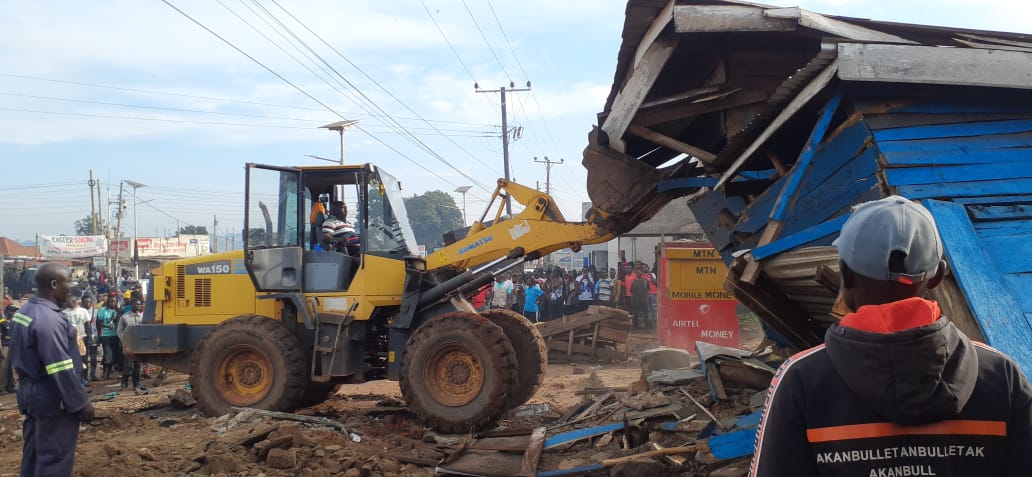
The Mukono demolitions have triggered widespread distress after authorities launched a forceful operation that left traders counting heavy losses across the municipality. Residents woke up to the sound of enforcement teams moving through trading zones, marking the start of a chaotic morning that disrupted livelihoods and sparked anger.
Authorities began the Mukono demolitions at around 5:00 a.m. in Kavule village before extending the operation to Total Village, Mulyanti Road, Nasuuti, Wantoni, and nearby areas. Law enforcement officers, supported by the Uganda Police Force and the Uganda People’s Defence Forces, supervised the demolition of makeshift structures and forced entry into business premises.
Eyewitnesses described scenes of panic as traders rushed to salvage goods. Many struggled to carry equipment and stock out of collapsing structures. Some broke down in tears while others fainted due to shock. The speed and scale of the Mukono demolitions overwhelmed many small business owners who depended on daily income.
Harriet Nansubuga, a phone repair technician, said the operation destroyed her shop along Nasuuti Street without warning. She explained that she had taken a loan of Shs10 million to expand her business. Now, she faces uncertainty about how to recover. Her story reflects the struggles many traders now face after the Mukono demolitions wiped out their investments.
Several affected traders say they can no longer meet loan obligations. Many borrowed money from banks and government livelihood programs to support their businesses. The sudden losses have raised fears of widespread defaults, which could affect both families and financial institutions.
Francis Byabagambi defended the operation and stated that authorities had issued earlier directives ordering vendors to vacate roadside trading spaces. He emphasized that the Mukono demolitions form part of a broader plan to restore urban order and relocate traders to designated markets.
However, traders strongly dispute this position. Many argue that authorities gave them too little time to comply. Others insist that officials failed to provide clear relocation options. One trader questioned where they were expected to go, noting that they had no time to move goods or secure new premises before the Mukono demolitions began.
The operation has also exposed divisions among local leaders. John Bosco supported the enforcement, arguing that authorities had given traders enough time to relocate. He believes the municipality must enforce order to ensure proper urban planning.
In contrast, Hakim Kyeswa criticized the operation and warned that demolishing properties outside designated road reserves could violate the law. He urged affected traders to challenge the Mukono demolitions through the courts if authorities acted beyond their mandate.
Tensions have continued to rise, especially in Wantoni trading centre. A group of youths from the Beghazi ghetto has announced plans to take legal action against municipal authorities. They claim officials destroyed properties that were not located on road reserves, raising concerns about fairness and legality.
As enforcement continues, many traders have started removing their goods in fear of further losses. The Mukono demolitions have forced business owners into a race against time as they try to protect what remains of their livelihoods. Some now operate in temporary spaces, while others have shut down completely.
The situation highlights the ongoing challenge of balancing urban order with economic survival. Authorities aim to regulate trade and improve city planning, yet traders depend on these spaces for daily income. The Mukono demolitions have therefore sparked a deeper debate about how cities should manage informal businesses without causing widespread hardship.
For many families, the impact goes beyond financial loss. Children’s school fees, rent payments, and daily expenses now hang in the balance. The destruction of small businesses has created uncertainty that extends far beyond the trading centres.
The Mukono demolitions now stand as a critical moment for policymakers. Leaders must find a way to enforce regulations while protecting livelihoods. Without clear communication, proper planning, and fair relocation strategies, similar operations could continue to trigger unrest and economic disruption.
As Mukono grapples with the aftermath, attention now shifts to whether authorities will engage affected traders and provide practical solutions. The coming days will determine whether the municipality can restore order without deepening the crisis faced by its business community.
READ: Ggaba School Attack Suspect Had Mental Illness History