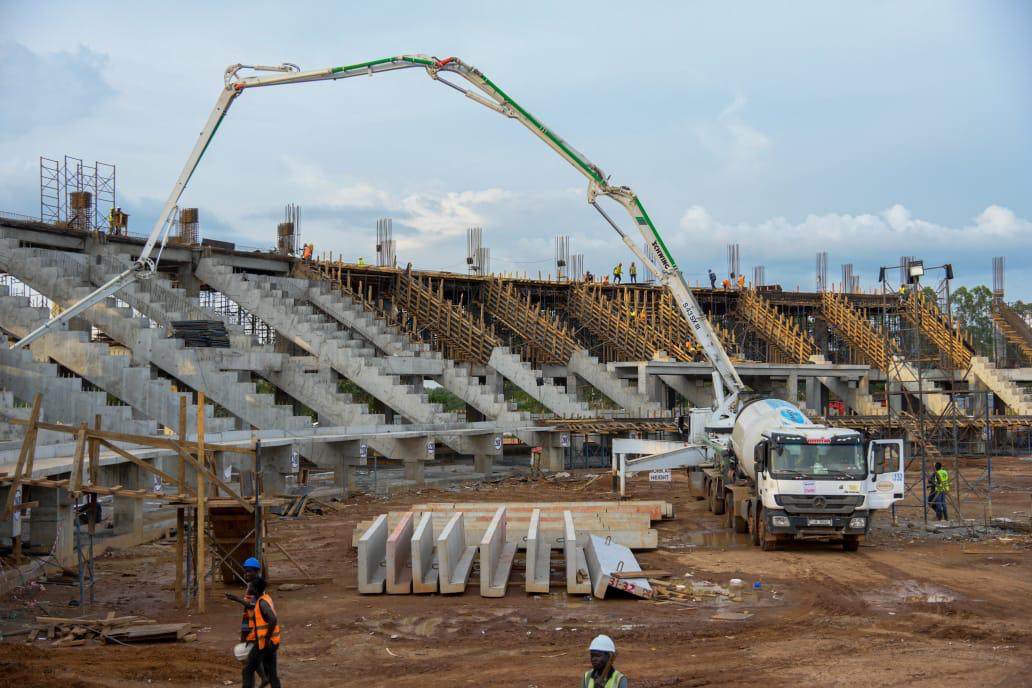
Akii-Bua stadium construction has reached nearly 50 percent completion in Lira City, marking a major milestone in Uganda’s expanding sports infrastructure. The project is progressing ahead of schedule, raising optimism that the multi-billion facility could be delivered earlier than planned.
To begin with, several critical components of the Akii-Bua stadium construction have already taken shape. Engineers have completed the reinforced concrete ground floor for both the hostel and clubhouse. In addition, teams have finalized excavation works for the swimming pool and changing rooms. As a result, the project has moved steadily into advanced construction phases.
At the same time, infrastructure development around the stadium continues to show strong progress. Workers have completed drainage systems for both training pitches, including one with an athletics track and another without. Meanwhile, construction of the perimeter wall has reached 40 percent. Therefore, the supporting structures are developing alongside the main facility.
During a recent inspection, Peter Ogwang praised the pace of work. He confirmed that the contractor is ahead of schedule and could complete the project earlier than the initial 18-month timeline. Consequently, the government now expects significant progress before the end of the year.
Moreover, the Akii-Bua stadium construction forms part of a broader national vision to improve sports facilities across Uganda. Officials credit Yoweri Museveni for initiating the project, which aims to bring modern sports infrastructure to Northern Uganda.
The facility will feature multiple sports amenities. These include a standard football pitch, an athletics track, a rugby-compatible field, and a semi-Olympic swimming pool. In addition, developers will build outdoor courts and an indoor arena to support various sporting activities. As a result, the stadium will serve as a multi-purpose complex.
Furthermore, accommodation plans form a key part of the project. The complex will include a hostel capable of housing up to 150 athletes. Therefore, it will support both training programs and major competitions.
Meanwhile, project managers continue to focus on quality and efficiency. According to Eng. Mohamed Nazih, roofing works are progressing steadily, with about 25 percent already completed. He explained that teams are working in phases to ensure durability while maintaining the construction timeline.
In addition, workers are applying sealants and protective measures to prevent water damage. This step ensures that the structure remains strong and long-lasting. Consequently, the project balances speed with quality control.
At the same time, engineers plan to complete sensitive sections, such as the pitch area, in the final stages. This approach prevents damage during earlier construction activities. Therefore, the team aims to deliver a high-quality playing surface.
The Akii-Bua stadium construction also carries significant regional importance. Once completed, the facility will help position Lira City and the wider Lango Sub-region as a hub for sports development. As a result, it could attract both local and international competitions.
Moreover, the government is preparing the stadium for major continental events. Officials intend to invite the Confederation of African Football and World Athletics to assess the facility. This step will ensure that it meets international standards ahead of the Africa Cup of Nations 2027.
In addition, authorities have identified the stadium as a potential backup venue for the tournament. Therefore, completing the project on time remains a top priority.
At the same time, leaders are calling on the private sector to invest in complementary infrastructure. Minister Ogwang urged local investors to develop high-quality hotels and related services. Consequently, this support will help accommodate the expected influx of visitors during major events.
Looking ahead, the long-term impact of the Akii-Bua stadium construction could extend beyond sports. The facility may boost tourism, create jobs, and stimulate economic activity in Northern Uganda. Therefore, it represents both a sporting and economic investment.
In conclusion, the progress of the Akii-Bua stadium construction reflects strong coordination between government, engineers, and contractors. As work continues ahead of schedule, the project stands as a symbol of Uganda’s commitment to sports development and regional growth.