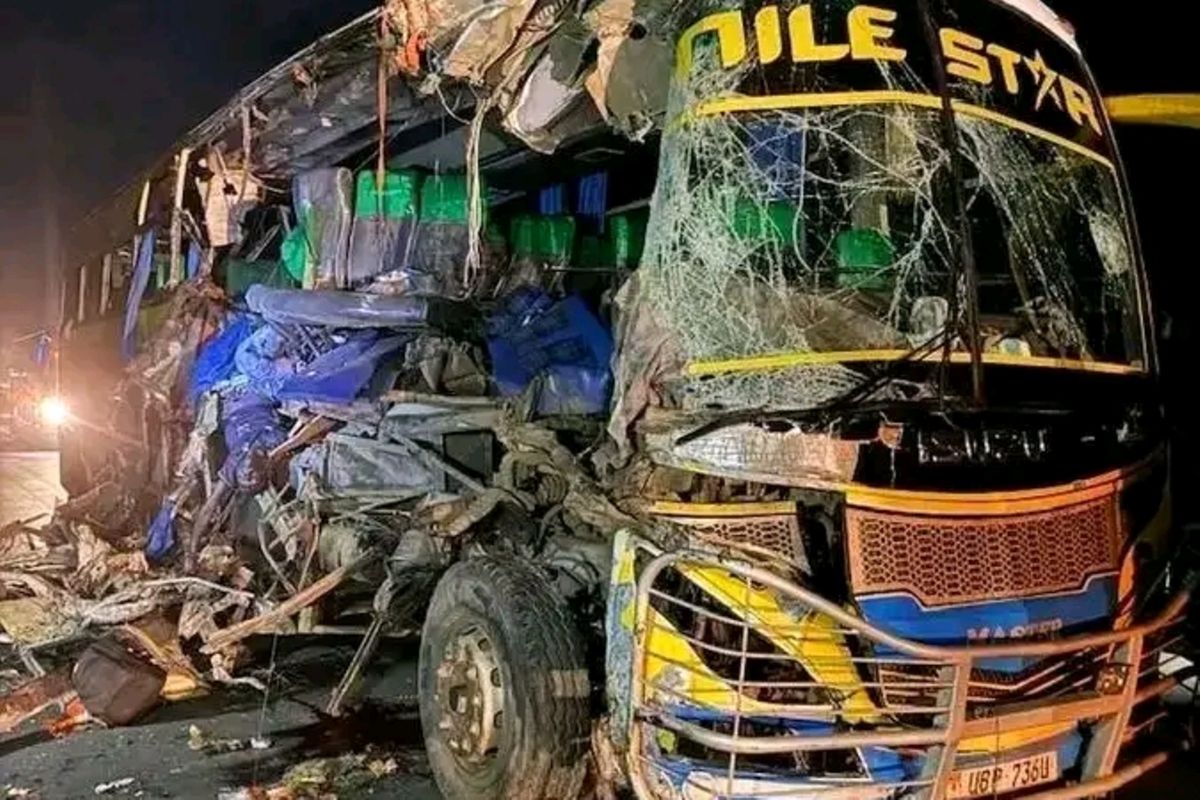
The Nwoya bus crash has killed at least six people and injured several others after a Nile Star Bus collided with a trailer early Monday morning.
The crash occurred at around 2am in Purongo Town Council, Nwoya District, along the Pakwach-Olwiyo-Karuma Highway. At the time, the bus, registration UBP 736U, was carrying about 67 passengers from Arua to Kampala. Meanwhile, the trailer lorry, registration SSD 498C, was transporting fish toward the Democratic Republic of Congo. As a result, the collision caused severe damage and multiple casualties.
However, officials released different figures after the Nwoya bus crash, reflecting confusion in the immediate aftermath. Nwoya Resident District Commissioner Mr Christoher Omara confirmed six deaths by Monday morning. In addition, he said 14 injured passengers were admitted to Anaka General Hospital. He further attributed the crash to reckless driving and promised more updates as investigations continue.
On the other hand, a Nile Star Bus manager reported a lower death toll. According to the manager, four people died on the spot. Furthermore, he stated that 13 injured passengers were taken to Kiryandongo Hospital. Meanwhile, the remaining passengers continued their journey to Kampala in a replacement bus. The company, therefore, moved quickly to manage the situation and assist travelers.
Similarly, local leaders described the Nwoya bus crash as severe. Nwoya LC5 Chairperson Mr Emmanuel Orach said responders encountered a disturbing scene. He explained that emergency teams acted swiftly to rescue survivors. As a result, health workers transported victims to Anaka General Hospital. Subsequently, doctors began preparations to transfer critical cases to St Mary’s Hospital Lacor in Gulu City.
At the same time, medical teams at Anaka General Hospital continue to treat several injured passengers. Most patients suffered fractures and internal injuries. Because the hospital serves a wide rural population, it often faces pressure during major emergencies. Therefore, quick referrals remain essential for patients with severe trauma.
Meanwhile, police responded quickly to the Nwoya bus crash and secured the scene. Aswa West police spokesperson Mr David Ongom Mudong confirmed the incident. However, he noted that officers were still gathering details. In the next phase, investigators will examine driver conduct, vehicle condition, and road conditions at the time of the crash.
Notably, the highway where the crash occurred handles heavy traffic every day. For instance, buses and cargo trucks use it to connect northern Uganda with central regions and neighboring countries. As a result, many drivers travel at night to meet delivery schedules. Consequently, experts warn that fatigue and speeding significantly increase accident risks on such routes.
According to the Uganda Police Force, reckless driving remains a leading cause of crashes. Therefore, road safety experts continue to call for stricter enforcement of traffic laws. In addition, they urge authorities to improve driver training and vehicle inspections to reduce accidents.
Although many passengers survived the Nwoya bus crash with minor injuries, the impact extends beyond physical harm. In fact, such incidents often leave lasting psychological effects. For this reason, health experts emphasize the need for follow-up care and trauma support for survivors.
Overall, the crash adds to a rising number of serious road accidents in Uganda. Consequently, authorities face growing pressure to act. Experts recommend tighter controls on commercial drivers and better road infrastructure. Moreover, improved lighting and signage could reduce risks on busy highways.
Ultimately, the Nwoya bus crash highlights the human cost of road safety failures. Each life lost deeply affects families and communities. In the coming days, investigators will release more details. These findings, in turn, may shape future efforts to prevent similar tragedies on Uganda’s roads.