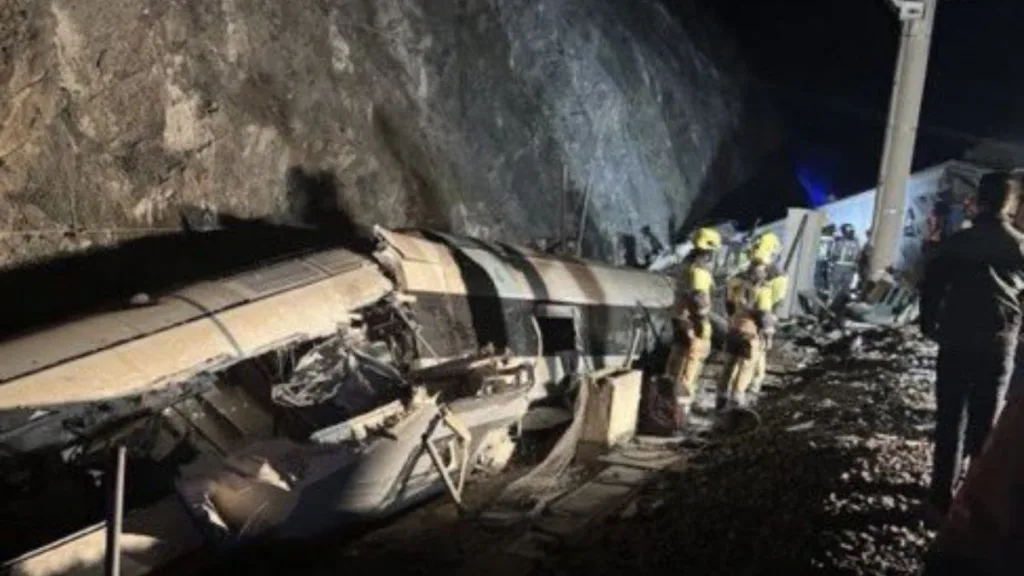
The Spain train collision 2026 killed at least 21 people and injured dozens more. In fact, it is Spain’s worst rail disaster in over ten years. The crash happened in Adamuz, near Córdoba. Specifically, a Madrid-bound train derailed and crossed onto the opposite track. Then, it slammed into an oncoming train. As a result, authorities warn the death toll could still rise.
About 400 passengers and staff were on both trains. Moreover, Andalusia’s emergency services reported 24 serious injuries, including four children. Notably, most of the dead and critically hurt were in the front carriages of the second train. This is because the impact shoved those carriages into an embankment.
Spanish Transport Minister Óscar Puente called the crash “extremely strange.” He added that all railway experts the government consulted are “extremely baffled.” Importantly, the derailment occurred just ten minutes after the train left Málaga at 18:40 local time. It happened on a straight stretch of high-speed track heading to Madrid. However, investigators have not yet found the cause. Consequently, Puente said they need at least a month to complete their report.
The train involved was a Freccia 1000 model. According to Ferrovie dello Stato, Italy’s state rail company, it can reach speeds up to 400 km/h (250 mph). Unfortunately, rescue teams struggled with the twisted wreckage. For example, Córdoba fire chief Francisco Carmona told RTVE, “We had to remove a dead person to reach someone alive. It is hard, tricky work.”
Salvador Jiménez, an RTVE journalist, was in the first carriage. He recalled that the impact felt like an “earthquake.” Meanwhile, video from the scene shows overturned carriages. Emergency workers immediately climbed through windows and doors to pull out survivors. One passenger, José, described the chaos: “People were screaming and calling for doctors.”
In response, officials immediately suspended all rail services between Madrid and Andalusia. Therefore, trains will not run on this route through Monday. Additionally, private operator Iryo said about 300 passengers were on the derailed train. At the same time, state-run Renfe confirmed roughly 100 people were on the other train.
Rescue teams quickly set up medical posts near the crash site in Adamuz. Soon after, hospitals started treating the injured. Furthermore, Adif opened family support centers at major stations—Atocha, Seville, Córdoba, Málaga, and Huelva. The Spanish Red Cross also sent counselors and support staff. They explained that families feel “great anxiety” because information is still limited.
On the national front, leaders expressed deep sorrow. Prime Minister Pedro Sánchez stated it was a “night of deep pain.” Similarly, King Felipe VI and Queen Letizia offered “heartfelt condolences” to the bereaved. They also wished the injured a swift recovery. Earlier, Adamuz mayor Rafael Moreno arrived at the scene. He described it as “a nightmare.”
Internationally, leaders responded with solidarity. For instance, French President Emmanuel Macron wrote, “My thoughts are with the victims, their families, and all Spaniards. France stands by your side.” Likewise, Italian Prime Minister Giorgia Meloni and European Commission President Ursula von der Leyen shared similar messages.
This tragedy brings back memories of the 2013 Galicia derailment. Back then, a crash killed 80 people—the deadliest in Spain’s high-speed rail history. Today, Spain runs the world’s second-largest high-speed rail network. It stretches over 4,000 kilometers and links more than 50 cities. Nevertheless, the Spain train collision 2026 raises urgent questions about safety and oversight.
Now, investigators have begun their work. In the meantime, the nation mourns. Above all, everyone’s focus remains on rescue, recovery, and supporting grieving families.
READ: Kigezi Voters Oust 10 Incumbent MPs in 2026 Uganda Election