The gender disparity in Uganda’s banking sector is hard to miss. On one hand, foreign investors own most banks. On the other, Ugandans—mostly men—run them. Women are well-represented in entry-level and mid-tier roles, but they rarely make it to the top. This isn’t just about fairness; it affects how banks serve the public and who gets a say in key decisions.
To begin with, Uganda’s banking industry is overwhelmingly foreign-owned. According to the Bank of Uganda Annual Supervision Report 2025, 89% of commercial banks are controlled by shareholders from outside the country—mainly Nairobi, Johannesburg, Lagos, and London. Only 11% remain locally owned. Yet, despite this external ownership, leadership stays firmly Ugandan. In fact, Ugandans hold 67% of board seats and 64.4% of CEO positions. So while capital flows in from abroad, strategic control remains local.
However, “local” doesn’t automatically mean “inclusive.” When we look closer at who holds power, the gender disparity in Uganda’s banking sector becomes even clearer. Men occupy 66% of board seats, compared to just 34% for women. What’s more, 68% of board chairpersons are men—and 90% of those chairs are Ugandan. This shows that foreign owners largely trust local men with top governance roles, not women.
Now, let’s consider staffing data from the Uganda Bankers Association (UBA). As of December 2024, the sector employed 19,571 people. Men made up 53% of the workforce, women 47%. At first glance, that seems fairly balanced. But when you break it down by level, a different story emerges.
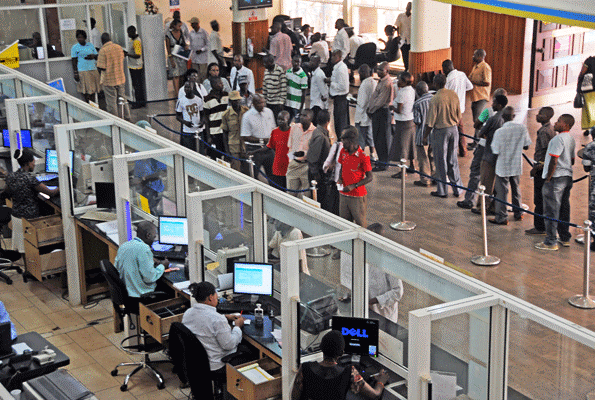
For instance, women dominate junior roles. They hold 56% of supervisory and junior management positions—such as branch managers, relationship officers, and customer service leads. Similarly, in frontline roles like tellers, clerks, and administrative staff, women account for 54% of the workforce. These jobs are essential for daily operations, yet they carry little influence over strategy or policy.
That said, the picture changes dramatically as roles become more senior. In senior management—roles like heads of risk, finance directors, or compliance officers—men hold 62% of positions. Women, by contrast, hold only 38%. Even more striking is the executive level: of the 59 bank CEOs, nearly 80% are men. That means just one in five CEOs is a woman. Likewise, on executive committees, men hold 61% of seats versus 39% for women.
Clearly, there’s a bottleneck in career progression. Women enter the banking sector in strong numbers and perform well in operational roles. Yet, they struggle to move into strategic leadership. In other words, the gender disparity in Uganda’s banking sector isn’t about recruitment—it’s about advancement. Without intentional support, many hit an invisible ceiling just before the top.
Importantly, the Bank of Uganda has flagged this as a structural issue. While local leadership strengthens institutional stability, the lack of gender balance at decision-making levels limits diverse perspectives. Moreover, it hampers efforts toward true financial inclusion. After all, women drive much of Uganda’s informal economy. Banks that reflect their realities can design better products and services for them.
Fortunately, progress is possible. For example, Rwanda and South Africa have narrowed gender gaps through board diversity targets, leadership pipelines, and transparent promotion criteria. Uganda could follow a similar path. Banks might adopt measurable diversity goals, strengthen mentorship programs, and create clear pathways from mid-level roles to executive leadership. Regulators and the UBA can also play a role by tracking progress and sharing best practices.
In short, the gender disparity in Uganda’s banking sector remains a defining feature of its leadership model. Foreign capital funds the system, but Ugandan men run it. Women are present—but not yet in power. Addressing this gap isn’t just about equity. It’s about building a more resilient, representative, and responsive financial sector for everyone.
READ: Balimwezo Leads Kampala Lord Mayor Race Amid Low Turnout