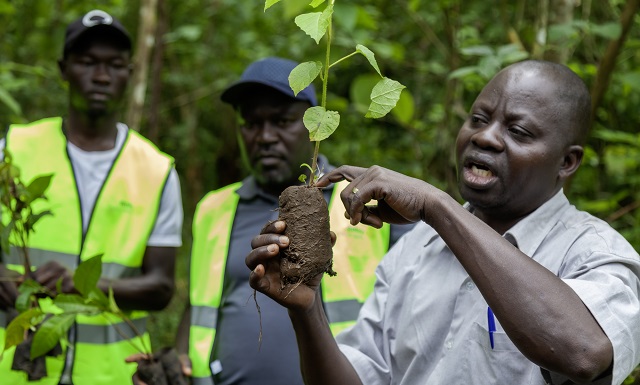
Namananga forest restoration has gained momentum as Uganda Breweries Limited launches a major environmental initiative aimed at rebuilding degraded ecosystems and strengthening climate resilience in Kayunga District.
The three-year project, implemented in partnership with the National Forest Authority and Rotary International, will see the planting of 80,000 indigenous trees across Namananga Central Forest Reserve. With a total investment of UGX 372 million, the initiative forms part of Uganda Breweries Limited’s 80th anniversary activities and reflects a broader commitment to sustainability.
At launch, stakeholders emphasized the ecological importance of Namananga Forest. The reserve covers 459 hectares and serves as a critical natural corridor linking Mabira Forest and Musamya Swamp. As a result, it supports biodiversity movement while also protecting key water sources such as the Nalwe and Wugula streams. These water systems sustain nearby communities, agriculture, and wildlife.
Felicite Nson, Managing Director of Uganda Breweries Limited, highlighted the company’s long-term environmental vision. She explained that the business depends heavily on natural resources, particularly water and agricultural inputs. Therefore, the Namananga forest restoration project directly supports the sustainability of the company’s value chain.
During the launch event, teams planted 2,000 seedlings, bringing the total number already planted under the initiative to 26,000. This early progress signals strong commitment from all partners involved. Moreover, it sets a solid foundation for achieving the target of 80,000 trees within the planned timeline.
The project also comes at a crucial time for Uganda’s environmental agenda. Currently, the country’s forest cover stands at approximately 13.3 percent. However, national development targets aim to restore it to 24 percent. In this context, the Namananga forest restoration effort contributes directly to reversing deforestation and rebuilding natural ecosystems.
Importantly, the initiative prioritizes indigenous tree species. These species adapt better to local conditions and support long-term ecological stability. In addition, they enhance biodiversity, regulate local temperatures, and protect soil and water systems. Consequently, this approach ensures that the restoration delivers lasting environmental benefits rather than short-term gains.
Collaboration remains central to the success of the project. The National Forest Authority plays a key role in guiding technical implementation and ensuring sustainable forest management practices. At the same time, Rotary International supports community engagement and environmental awareness. Together, these partnerships strengthen the impact of the Namananga forest restoration initiative.
Martin Mwodi Kegere, Director of Plantations Development at the National Forest Authority, stressed the importance of long-term stewardship. He noted that tree planting alone does not guarantee success. Instead, sustained care and protection determine whether the forest will thrive. Therefore, stakeholders have committed to ongoing monitoring and management throughout the three-year period.
Geoffrey Martin Kitakule, representing Rotary International, also emphasized the value of partnerships. He pointed out that large-scale environmental projects require coordinated efforts across sectors. Furthermore, he praised Uganda Breweries Limited for integrating environmental conservation into its anniversary celebrations, setting an example for corporate responsibility.
Beyond planting trees, the UGX 372 million investment supports maintenance, monitoring, and community involvement. These elements ensure that seedlings grow into mature trees and deliver measurable ecological impact. As a result, the Namananga forest restoration project focuses on sustainability rather than symbolic action.
Communities surrounding the forest stand to benefit significantly. Restored forest cover will protect water sources, improve soil fertility, and support agriculture. In addition, healthier ecosystems can create opportunities for eco-tourism and local livelihoods. Therefore, the initiative aligns environmental protection with economic and social development.
The project also highlights the growing role of the private sector in environmental conservation. Companies increasingly recognize that sustainability drives long-term business success. In this case, Uganda Breweries Limited demonstrates how corporate investment can support national environmental goals while strengthening its own operations.
Looking ahead, stakeholders will measure success through clear outcomes. These include increased forest cover, improved water system protection, and stronger ecosystem resilience. At the same time, continuous community engagement will ensure that local populations actively participate in protecting the forest.
Ultimately, the Namananga forest restoration initiative represents more than a tree-planting campaign. Instead, it signals a coordinated effort to restore Uganda’s natural heritage and secure its ecological future. With strong partnerships, sustained investment, and clear goals, the project has the potential to become a model for similar conservation efforts across the country.